

Election staff in Bundi voted using postal ballot
Election staff appointed for the third phase of the Panchayati Raj General Election 2026 in Talera Panchayat Samiti, Bundi, voted on Monday through postal ballot.
District · Kota division
Politics, administration, crime, education, farming and every local story from Bundi district (Kota division).
Election staff appointed for the third phase of the Panchayati Raj General Election 2026 in Talera Panchayat Samiti, Bundi, voted on Monday through postal ballot.

Rajasthan Technical University Kota’s chief secretary Bhavna Sharma was appointed election supervisor of Bundi district on 2 November

District Collector Harphool Singh Yadav instructed the district-level peace committee to celebrate religious festivals, events and processions in Bundi with peace and harmony.

On 30 October, in Bundi district, the second randomisation of EVMs and reserve EVMs at polling stations under Panchayati Raj General Election‑2026 was held at the district collector’s hall

On 30 October, during the Scout and Guide district headquarters training camp in Bundi, a voting awareness rally, corner play and public awareness seminar were organised under the chief hospitality of Assistant State Organisation Commissioner Dr Dilip Kumar Mathur

Under the Panchayati Raj General Election 2026, mail ballot voting will be conducted on 2 and 13 November in Bundi; election staff received training and instructions.

Bundi, 30 October. Under the Panchayati Raj General Election 2026, local information for the fourth phase in the district will be released on 31 October. In the fourth phase, elections will be held for members of the Panchayat Samiti of Bundi, Khattakar, Dablana, Hindoli, Nainwan, Lakhery, and Keswaraypatan, as well as for district council members and Panch and Sarpanch posts.

Special monitor of National Human Rights Commission, Dhananjay Tingl, in Bundi, said legal process must be followed for rehabilitation of child and bonded labourers

Bundi’s Kumbha Stadium will host the ‘Bundi Industry and Handicraft Fair‑2026’ from 28 November to 7 December. Additional District Collector Ramesh Dev set security, cleanliness and facilities in a preparation meeting.

Winners of ‘Develop India Youth Parliament‑2027’ in Bundi will participate at state level. Registration open till 31 October 2026.

First randomisation of EVMs for the third and fourth phases of Panchayati Raj elections‑2026 was completed on 27 October at the District Collectorate Hall in Bundi, chaired by District Election Officer Harphool Singh Yadav.

At the Boondi district road safety committee meeting, District Collector Harphool Singh Yadav instructed the preparation of a concrete action plan to control road accidents and its ground-level implementation.

Micro ATMs handed to secretaries of 5 dairy committees in Bundi district, enabling payment to livestock owners at the cooperative committee level

Under the 2026 Panchayati Raj elections in Boondi, 61 candidates filed nominations for district council seats across 27 wards and 69 candidates for Taleeda panchayat committee, while some withdrew.
Bundi district is a district in Rajasthan, India, with its headquarters in the city of Bundi. It covers 5,550 km² and had a population of 1,110,906 in 2011.
Bundi district is a district in the state of Rajasthan in western India. The city of Bundi serves as the district headquarters. The district covers an area of 5,550 km² and had a population of 1,110,906 according to the 2011 census.
The district is administratively divided into five tehsils: Bundi, Hindoli, Nainwa, Keshoraipatan, and Indergarh.
Bundi city itself is located in the Hadoti region of Rajasthan, which lies in the northwest part of the state.
Stone Age tools dating from 5,000 to 200,000 years before present were found in Bundi and Bhilwara districts of Rajasthan. The south‑east region of the state, known as Hadoti, is the land of the Hada Rajputs, a major branch of the Chauhan Agnikula Rajputs. They settled in the hilly terrain of Mewar at Bambaoda, near Bijoliya, in the 12th century CE.
Bundi was established in 1241 CE by Rao Deva Singh, marking the first step in the establishment of Hadauti when the Hadas moved down from the ‘Pathar’ around Bambaoda. The town takes its name from the Bando Naal, a narrow passage between rugged hills, and is nestled in a cleft of the Aravalli Range, giving it a medieval flavor untouched by time.
Prince Jait Singh of Bundi captured Kota in 1264 AD, making it part of Bundi as the Jaghir of the eldest prince. Kota later became a separate state in 1624, and the state of Jhalawar was formed in 1838 out of Kota territory.
After the siege of Ranthambore in 1568, Rao Surjan Singh of Bundi signed a treaty with the Mughal Empire, retaining significant autonomy. In 1818, Rao Raja Bishan Singh allied with the British East India Company to counter Maratha influence. During the Raj, Bundi remained a princely state with regional independence. The last ruler signed the Instrument of Accession in 1949, joining the Dominion of India.
Bundi district lies in southeastern Rajasthan within the Hadoti region, sharing borders with Tonk to the north, Bhilwara to the west, Chittorgarh to the southwest, and Kota to the east. The Chambal River forms the southeastern boundary, separating Bundi from Kota.
A double range of hills runs from the northeast to the southwest across the district, effectively dividing it into two roughly equal halves. The southern slopes of this range are steep escarpments, making passage difficult. Four passes cut through the hills: one at the city of Bundi, another at Jainiwas to the east, a gorge between Khatgarh and Ramgarh carved by the Mez River, and a fourth near Lakheri.
The plains to the northwest of the hills are drier, with hard, stony soil. In contrast, the southeastern plains enjoy a wetter climate and more fertile soils, including rich alluvial deposits along various streams and sandy loam in other areas.
The district experiences a hot semi‑arid climate (BSh). Rainfall is insufficient for a tropical savanna classification and is largely confined to the summer monsoon months of June to September. Summers are quite warm and humid.
Bundi district, according to the 2011 census, had a population of 1,110,906, placing it 415th among Indian districts. The population density was 193 inhabitants per square kilometre, and the district experienced a growth rate of 15.7% between 2001 and 2011. The sex ratio stood at 922 females for every 1,000 males, while the overall literacy rate was 62.31%. About one fifth of residents lived in urban areas, and Scheduled Castes and Scheduled Tribes comprised 18.97% and 20.57% of the population, respectively.
In terms of language, the 2011 census recorded that 76.02% of the district’s inhabitants spoke Hadauti as their first language. Hindi was spoken by 14.35% of the population, Rajasthani by 4.67%, and Malvi by 1.01%. These figures illustrate the linguistic diversity within Bundi, with Hadauti being the predominant mother tongue.
The town of Bundi itself, also recorded in the 2011 census, had a population of 103,286. The literacy rate in Bundi town was 72%, slightly below the national average of 74% at that time. The demographic and linguistic data together provide a snapshot of the people who inhabit Bundi district and the languages they use daily.
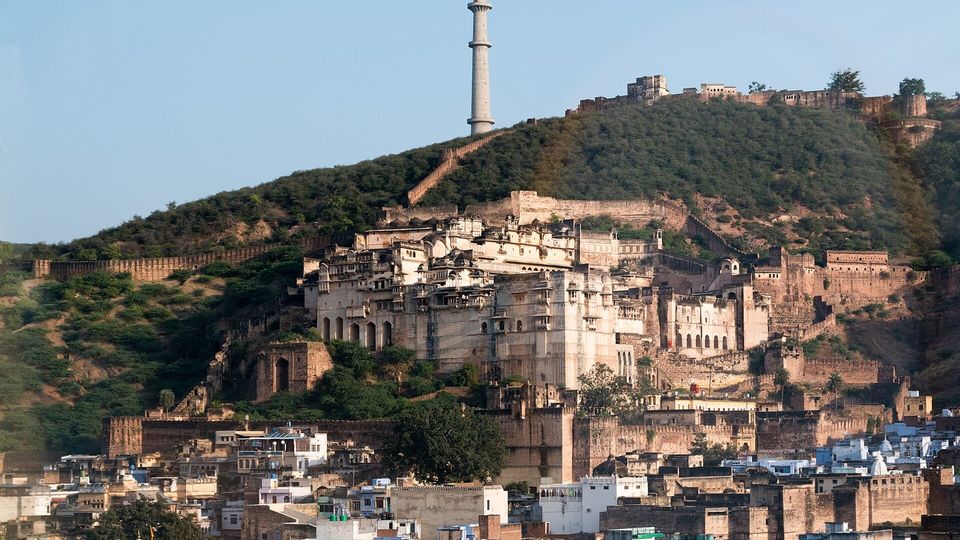
Taragarh Fort, perched high in the Aravalli mountain range, is a prominent landmark in Bundi district. Known as the "Star Fort," it was built in the 1400s by Rao Dev Hada. Below the fort, the Taragarh Palace was constructed about two centuries later during the reign of Rao Raja Ratan Singh (1607‑31). The palace served as the official residence of the Maharajas and is notable for its architecture, which contains very little Mughal influence and is built from green‑tinged stone rather than the sandstone typical of Rajput structures.
Bundi is also home to several temples that reflect the region's religious heritage. Among them is a partially submerged Varuna temple, situated in the middle of the artificial Nawal Sagar Lake. Another significant temple is the Charbhuja Nath Temple, dedicated to Charbhujanath, a four‑armed form of Vishnu, and located within the old city.
The district celebrates the Bundi Utsav, an annual festival that takes place for three days in Kartik, the eighth month of the Hindu calendar. First held in 1996, the festival features folk music, an arts and crafts fair, and traditional Rajasthani sports, drawing visitors to experience the local culture and traditions.
Based on: the Wikipedia article (CC BY-SA 4.0) — facts from that source; edited and translated by Times of Rajasthan.
Farm advisory
Sat
32° 18°
0% · 0mm
Sun
33° 19°
0% · 0mm
Mon
32° 18°
0% · 0mm
Tue
31° 17°
0% · 0mm
Weather: Open-Meteo forecast. General advice — ask your Krishi Vigyan Kendra or agriculture supervisor for doses.
 VISUAL STORY · WITH MUSICBundi Darshan▶ Watch & listen
READERS’ POLL
Vote to see the results
A proverb, a word and a district from the land of dunes — every day
PROVERB OF THE DAY
“पाणी पीजे छाण कर, गुरु कीजे जाण कर”
Strain water before you drink it; know a teacher before you follow one.
MARWARI WORD
मनवार
Lovingly insisting a guest eats and drinks a little more
DISTRICT OF THE DAY
Chittorgarh
FAIRS & FESTIVALS
This month: Pushkar Fair, Bundi Utsav
Kumbhalgarh Festival
Rajsamand · December
Discover Rajasthan →


