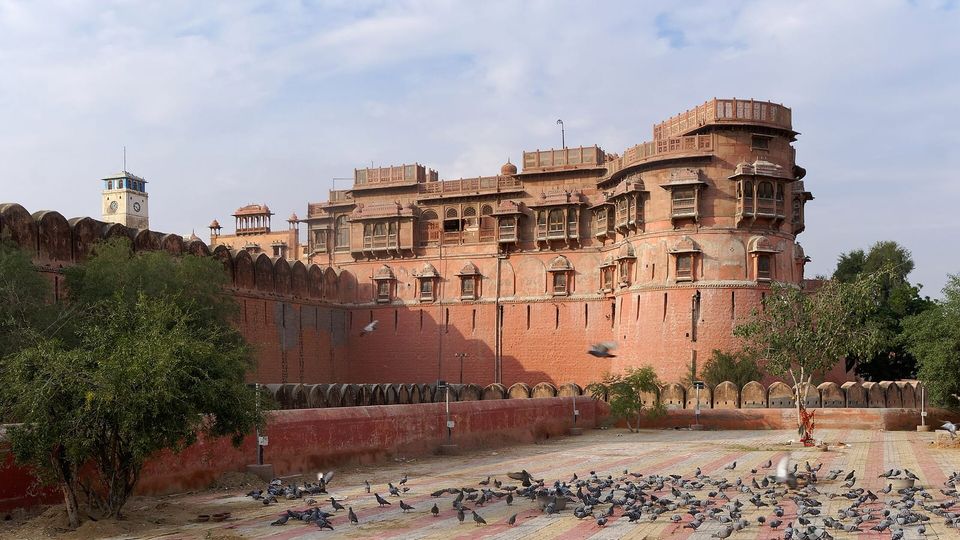
The Junagarh Fort, built around 1594 CE by Raja Rai Singh and originally called Chintamani, dominates the modern city of Bikaner. Unlike most Rajasthani forts, it was not erected on a hill but on flat ground, and it is surrounded by temples, grand palaces and large pavilions. In 1961 Maharaja Karni Singh established a museum within the fort, and many of its historic structures now serve as museums that illustrate the opulent lifestyle of past Maharanas.
The Bikaner Camel Festival, organized each year by the Department of Tourism, Government of Rajasthan, begins with a procession of decorated camels that set out from Junagarh Fort. The festivities then move to the Dr Karni Singh Stadium, where cultural performances and competitions are held, celebrating the region’s long association with camels.
Another major celebration is the International Camel Festival, held in January or February. This event, also overseen by the Department of Tourism, Art and Culture, includes a range of camel‑related competitions and popular contests such as Mr Bikana and Miss Marwan, further highlighting the animal’s cultural significance.
Religious sites add to Bikaner’s cultural landscape. The Karni Mata Temple, known as the Rat Temple, lies about 30 km south of the city in Deshnoke and is dedicated to the mystic Karni Mata, regarded as an incarnation of Durga. The shrine is famed for the small creatures that roam its precincts, which devotees consider reincarnated devotees rather than ordinary rats. Within the district, the Mukam Bishnoi Temple near Nokha marks the samadhi of Guru Jambheshwar, the founder of the Bishnoi sect, and serves as the principal pilgrimage centre for followers who observe strict environmental and compassionate principles.
Bikaner also hosts historic temples such as the Shri Laxminath Temple, built by Maharaja Rao Lunkaran and situated four kilometres from Junagarh Fort. Dedicated to Lord Vishnu and Goddess Laxmi, the temple is noted for its silver‑embellished doorway and vibrant celebrations of festivals like Janmashtmi and Diwali. The Bhandasar Jain Temple, constructed in the 15th century by Bhandasa Oswal, showcases intricate leaf paintings, frescoes and mirror work on red sandstone, and is devoted to the 5th Tirthankara, Sumatinatha.