Dilwara Temples
Welcome to a visual journey through the Dilwara Temples, where craftsmanship meets tranquility.

TIMES of RAJASTHAN · DARSHAN
Dilwara Temples
Welcome to a visual journey through the Dilwara Temples, where craftsmanship meets tranquility.
In detail
The Dilwara Temples are a group of Śvētāmbara Jain temples near Mount Abu in Rajasthan, dating from the 11th to 16th centuries and renowned for their pure white marble architecture. They are one of the five Maha tirths of the Svetambara sect and a major pilgrimage and tourist site.
Overview
The Dilwara Temples are a group of Śvētāmbara Jain temples situated about 2½ kilometres from the settlement of Mount Abu in the Sirohi District of Rajasthan, India’s only hill station. They are counted among the five Maha tirthas of the Śvētāmbara sect, alongside Shatrunjay, Girnar, Sammed Shikharji and Ashtapad, and are regarded as holding equal or greater importance than the other pilgrimage sites.
Construction of the earliest temples began under Vimal Shah, a Jain minister serving the Solanki king Bhima I of Gurjaratra. Subsequent additions were made by Vastupala, a Jain minister of the Vaghela rulers of the same region. The complex was built over several centuries, with its monuments dating from the 11th to the 16th century, and exemplifies the Solanki architectural style renowned for its pure white marble and intricate carvings.
The temples are celebrated for their exquisite marble work, which showcases some of the most refined examples of Jain temple architecture in Rajasthan. Their elaborate designs and the high quality of the stonework have made them a focal point for both religious pilgrims and general tourists.
Management of the Dilwara Temples is overseen by the Seth Shri Kalyanji Anandji Pedhi of Sirohi. As a major pilgrimage destination for Jains, the site also attracts a broad spectrum of visitors, contributing to its status as a significant cultural and tourist attraction in the region.
What it is like
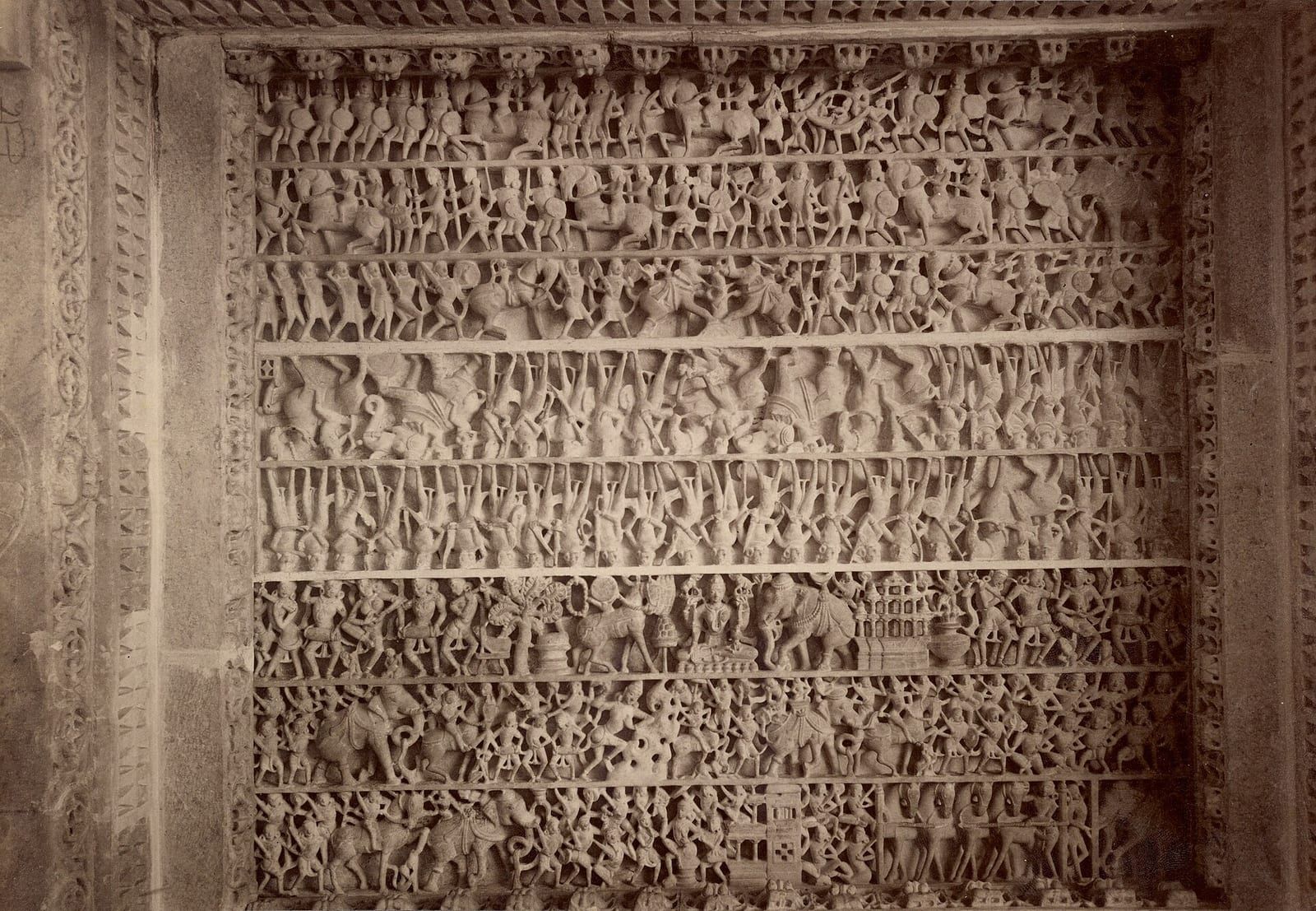
The Dilwara temples present a striking visual experience built entirely of white marble, a material that enhances their luminous quality and has remained a hallmark of Jain temple construction. Visitors encounter an opulent entranceway that, despite its richness, reflects Jain ideals of honesty and frugality through its overall simplicity of form. The interior spaces are adorned with intricately carved ceilings, doorways, pillars and panels, each element displaying a level of detail that is considered remarkable even by the high standards of the Māru‑Gurjara style.
The complex layout follows a clear axial progression. In the first three principal temples, the sanctuary is aligned with a closed mandapa, then an open mandapa, and finally a larger rangamandapa used for dance or drama. This sequence guides the visitor from the most intimate sacred space outward toward a broader communal hall, creating a sense of expanding spiritual space. Surrounding the main structures are cloister screens of devakulikā shrines, forming a curtain of smaller sanctuaries that encircle the core building; this feature became distinctive of West Indian Jain temples.
The oldest and largest two temples, Vimal Vasahi and Luna Vasahi, showcase especially elaborate carving, with Luna Vasahi reaching a peak of intricacy. Even the outer walls of the cloister screens remain relatively plain, allowing the interior ornamentation to dominate the visual impression. The use of pure white marble, first exemplified at Dilwara, set a standard that later Māru‑Gurjara temples sought to emulate, and it continues to be prized in contemporary Jain and Hindu constructions worldwide.
Based on: the Wikipedia article (CC BY-SA 4.0) — facts from that source; edited and translated by Times of Rajasthan.
More visual stories
 Folk musicKesariya Balam — the songs of the ManganiyarsMaand singing from the Thar, the hum of the kamaicha and the clack of the khartal.5 scenes · with music · ♥ 11
 Folk danceGhoomar — the dance of the swirling skirtSwirling ghagras, flowing veils and clapping rhythms at Gangaur, Teej and weddings.3 scenes · with music · ♥ 13
 Folk danceKalbeliya — the serpent dance, a UNESCO heritageBodies sway like serpents to the pungi; on UNESCO’s intangible heritage list since 2010.4 scenes · with music · ♥ 1
 PaintingPhad and Ravanahatha — a story that travelsThrough the night, the bhopa and bhopi sing the epic of folk deities before the phad, to the ravanahatha.4 scenes · with music · ♥ 5
Photos: Lala Deen Dayal / Wikimedia Commons (CC0) · Hellohappy / Wikimedia Commons (CC BY-SA 4.0) · ShubhamPaul&9 / Wikimedia Commons (CC BY-SA 4.0)