Blue pottery
The visual story showcases the vibrant craft of blue pottery from Rajasthan.
TIMES of RAJASTHAN · DARSHAN
Blue pottery
The visual story showcases the vibrant craft of blue pottery from Rajasthan.
In detail
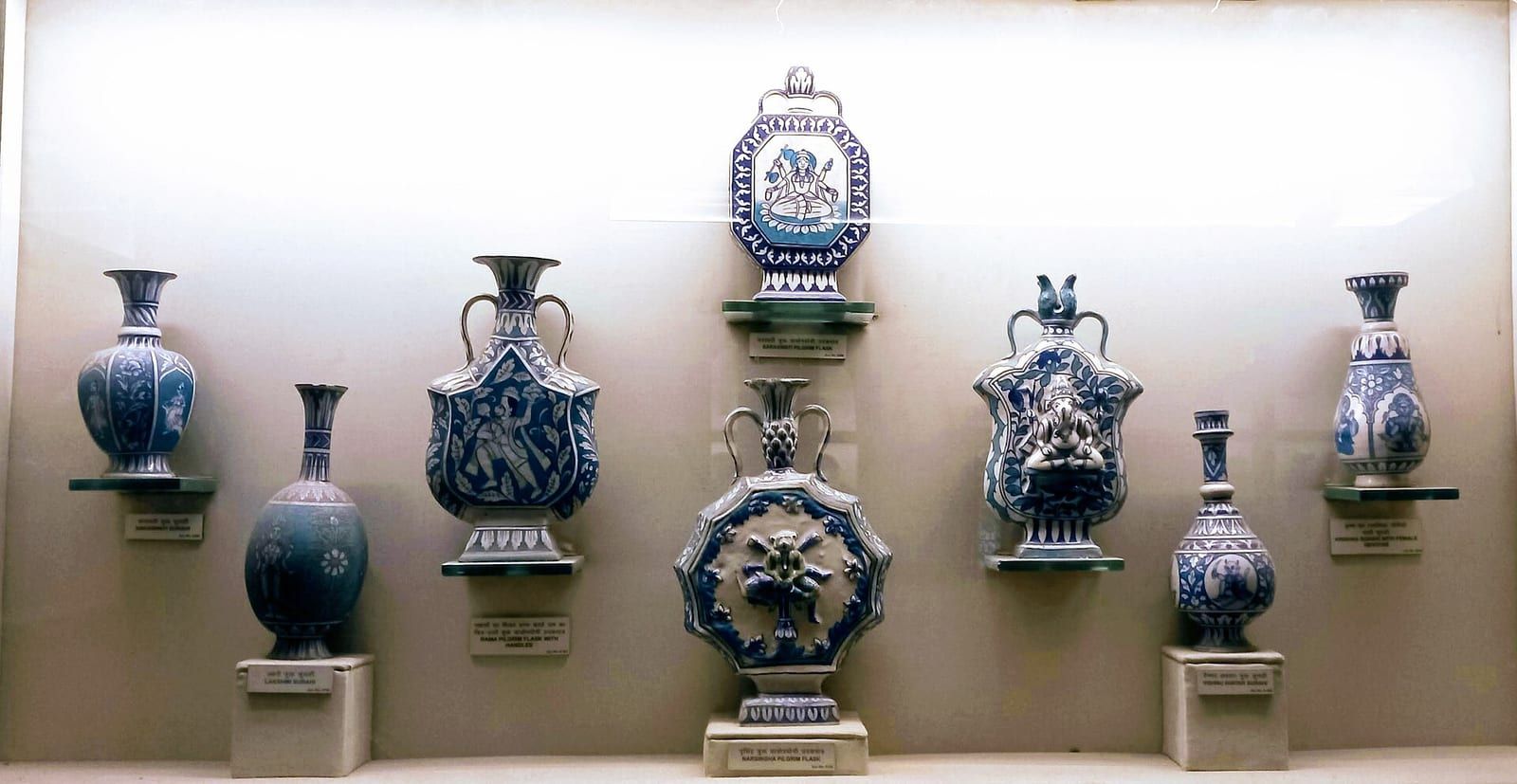
Blue pottery is a traditional craft of Jaipur, originating from Central Asia and named for its cobalt blue dye. It is made from a ceramic frit mixture, fired once at low temperature, and is known for its crack‑free, hygienic, and decorative qualities.
Overview
Blue pottery is widely recognized as a traditional craft of Jaipur of Central Asian origin. The name 'blue pottery' comes from the cobalt blue dye used to colour the pottery. It is one of many Eurasian types of blue and white pottery, and related in the shapes and decoration to Islamic pottery.
Jaipur blue pottery has been strongly influenced by the Persian ceramic style but it has developed its own designs and motifs. Inspired more from nature, the pottery is adorned profusely with animals, birds and flowers with a hint of Persian geometric design in the compositions. Some of this pottery is semi-transparent and mostly decorated with Mughal arabesque patterns and bird and other animal motifs.
Jaipur blue pottery, made out of ceramic frit material similar to Egyptian faience, is glazed and low-fired. No clay is used: the 'dough' for the pottery is prepared by mixing quartz stone powder, powdered glass, multani mitti (fuller's earth), borax, gum and water. Another source cites Katira Gond powder (a gum), and saaji (soda bicarbonate) as ingredients. Like pottery it is fired only once. The biggest advantage is that blue pottery does not develop any cracks, and blue pottery is also impervious, hygienic, and suitable for daily use. Blue pottery is beautifully decorated with the brush when the pot is rotated. Thus it has great utilitarian as well as aesthetic significance.
Being fired at very low temperature makes them fragile. The range of items is primarily decorative, such as ashtrays, vases, coasters, small bowls and boxes for trinkets. The colour palette is restricted to blue derived from the cobalt oxide, green from the copper oxide and white, though other non-conventional colours, such as yellow and brown are sometimes included. The products made include plates, flower vases, soap dishes, surahis (small pitcher), trays, coasters, fruit bowls, door knobs, and glazed tiles with hand painted floral designs. Sometimes, designer pieces for display are also made. The craft is found mainly in Jaipur, but also in Sanganer, Mahalan, and Neota.
History and origins
Blue and white wares first appeared in Iraq under the Abbasid Caliphate, where Abbasid potters had been using cobalt as an underglaze color on white glazed earthenware since the 9th century. The technique was introduced to China from Iraq, first applied to earthenware during the Tang dynasty (618–907 CE) and later to porcelain. Mongol artisans combined Chinese glazing technology with Persian decorative arts, and the blue glaze technique travelled east to India with early Turkic conquests in the 14th century. During its infancy it was used to make tiles to decorate mosques, tombs and palaces in Central Asia, and later, following their conquests and arrival in India, the Mughals began using them in India. Gradually the blue glaze technique grew beyond an architectural accessory to Indian potters, spreading to the plains of Delhi and, in the 17th century, to Jaipur.
Other accounts of the craft state that blue pottery came to Jaipur in the early 19th century under the ruler Sawai Ram Singh II (1835–1880). The Jaipur king had sent local artisans to Delhi to be trained in the craft. Some specimens of older ceramic work can be seen in the Rambagh Palace, where the fountains are lined with blue tiles. Sawai Ram Singh, in his reign (1835–1880), promoted art in Jaipur state with dedication. Legend says that impressed by the art of blue pottery, he brought artists from Delhi to Jaipur. However, Jaipur blue pottery introduced original innovations and mastered the art in such a way that it was claimed to have surpassed the Delhi pottery. Back in 1916, The Journal of Indian Art recorded that Jaipur ware was an improvement upon Delhi pottery.
His successor Sawai Madho Singh patronised an exhibition of industrial arts and crafts in 1883 in which finest blue pottery pieces were exhibited with other arts and crafts. Prized possessions of the exhibition were displayed in a museum‑like space in the exhibition. Many artisans had been trained in the school of art opened by Sawai Ram Singh and the then director of the school, Opendronath Sen, who had worked particularly to promote the blue pottery, was also happy to see it being showcased in the exhibition. Jaipur School indigenised the art of Blue Pottery through designs that were drawn from Indian life like Indian animals, Hindu deities, Indian human figures, features of Indian palaces etc.
However, by the 1950s, blue pottery had all but vanished from Jaipur, when it was re‑introduced through the efforts of the muralist and painter Kripal Singh Shekhawat, with the support of patrons such as Kamladevi Chattopadhaya and Rajmata Gayatri Devi. Today, blue pottery is an industry that provides livelihood to many people in Jaipur. Jaipur blue pottery, despite new innovations in vessels and designs, has retained the traditional blue and adheres to the traditional motifs rendering it instantly recognisable. The fountains inside the Polo Bar and the Maharani Suite within the Rambagh Palace complex are examples of some of the finest craftsmanship of Jaipur Blue Pottery and evidence the support of royal patronage to the art.
What it is like
Making blue pottery is a complex and time‑intensive procedure that involves many steps. The absence of clay distinguishes it from traditional pottery. The materials used are quartz stone powder, powdered glass, borax, gum, and Multani mitti (fuller’s earth). These are kneaded into a dough with water, rolled and flattened into a 4–5 millimetre thick ‘Chapatti’ and placed in moulds that contain a mixture of pebbles and ash.
The moulds are made from Plaster of Paris and are maintained carefully so they can be used repeatedly. After the mould is turned upside down and the product is removed, it is left to dry for one to two days. Once cleaned and shaped, the surface is polished with sandpaper to smooth it and prepare it for painting.
Motifs are painted over the polished surface and a final coat of glaze is applied. The fully dried product is then ready for the furnace. Artisans traditionally offer prayers before setting up the furnace, and some still do so today to pray for a successful bake.
Preparing the furnace is a delicate process; any misstep can cause cracks. The pieces are kept inside the furnace to dry, and for about four to five hours they are fired with meticulous care to maintain even temperatures and avoid cracks. After the firing, the artisans wait for the kiln to cool completely, which may take two to three days before the products can be taken out. The finished pieces are lightly cleaned before they are showcased or packaged.
Based on: the Wikipedia article (CC BY-SA 4.0) — facts from that source; edited and translated by Times of Rajasthan.
More visual stories
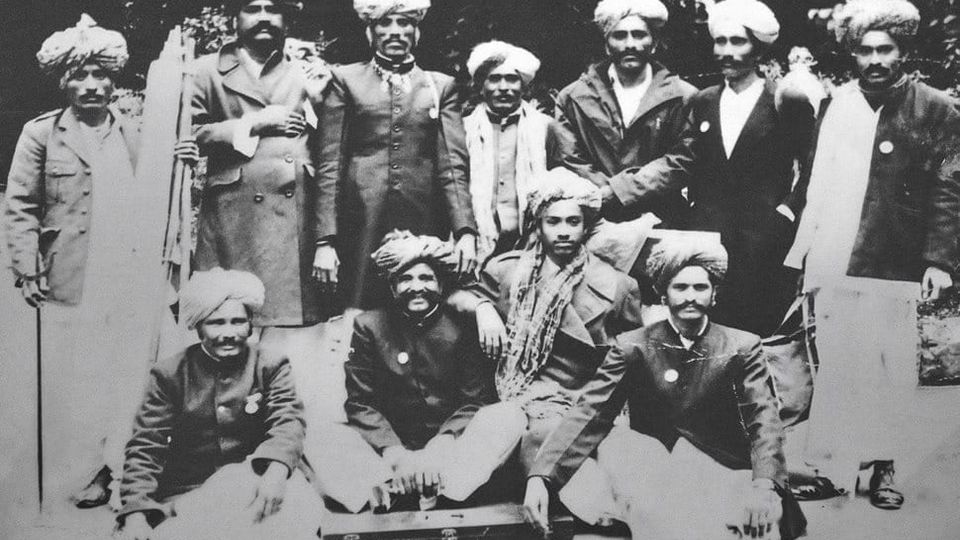 Folk musicKesariya Balam — the songs of the ManganiyarsMaand singing from the Thar, the hum of the kamaicha and the clack of the khartal.5 scenes · with music · ♥ 11
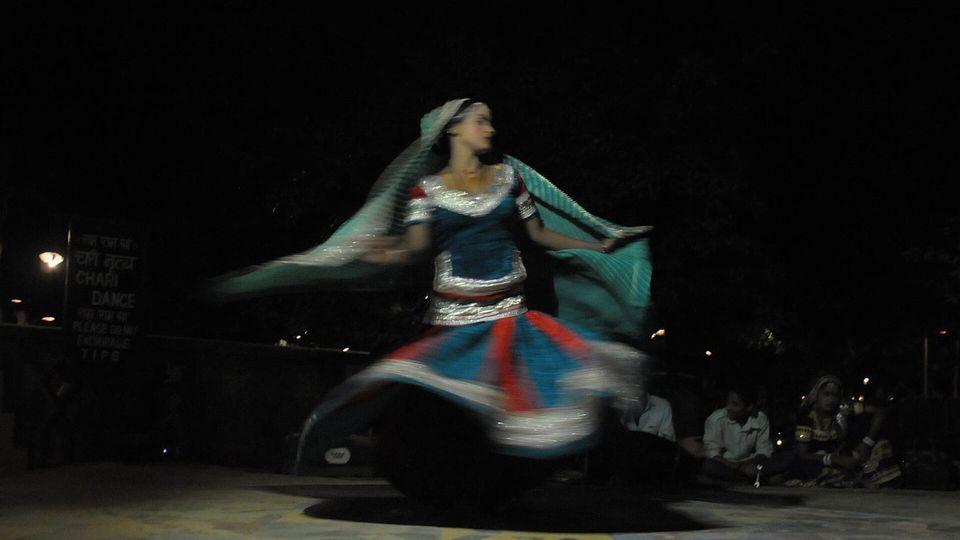 Folk danceGhoomar — the dance of the swirling skirtSwirling ghagras, flowing veils and clapping rhythms at Gangaur, Teej and weddings.3 scenes · with music · ♥ 13
 Folk danceKalbeliya — the serpent dance, a UNESCO heritageBodies sway like serpents to the pungi; on UNESCO’s intangible heritage list since 2010.4 scenes · with music · ♥ 1
 PaintingPhad and Ravanahatha — a story that travelsThrough the night, the bhopa and bhopi sing the epic of folk deities before the phad, to the ravanahatha.4 scenes · with music · ♥ 5