Skip to content

District · Jodhpur division

Jaisalmer News — Latest from Jaisalmer

Politics, administration, crime, education, farming and every local story from Jaisalmer district (Jodhpur division).

34°CClear · 22°/34°जैसलमेरAll alerts
KNOWN FORSonar Qila (Golden Fort)Sam sand dunesDesert FestivalPatwon ki Haveli

Stories from Jaisalmer will appear here soon. Meanwhile, read the latest from Rajasthan.

Sonar Qila (Golden Fort)Sam sand dunesDesert FestivalPatwon ki Haveli

About Jaisalmer

Jaisalmer district is the largest district in Rajasthan by area and the least populous among the state's districts as of 2011. It lies in the Thar Desert and borders Pakistan to the west and north.

Overview

Jaisalmer district is the largest district in Rajasthan and the third largest in India. It lies in the western part of the state, within the Marwar region of the Jodhpur Division. The city of Jaisalmer, nicknamed The Golden City, serves as the administrative headquarters of the district. It is situated about 289 kilometres from Jodhpur and 559 kilometres from Jaipur.

According to the 2011 population census, Jaisalmer district is the least populous district among the 50 districts of Rajasthan. The district’s main town, Jaisalmer, is located 575 kilometres west of Jaipur, in the heart of the Thar Desert.

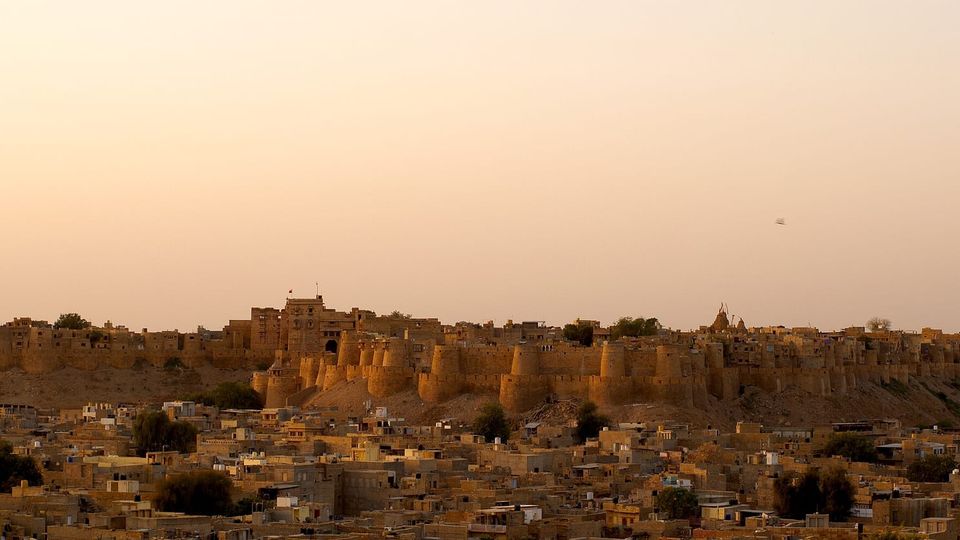
Jaisalmer city was founded in 1156 by Rawal Jaisal of the Bhati clan of Rajputs and was the historic capital of the kingdom of Jaisalmer. The city stands on a ridge of yellowish sandstone and is crowned by the World Heritage Site Jaisalmer Fort, a hilltop citadel with 99 bastions. The fort houses a royal palace and several ornate Jain temples, and many of the houses and temples in the fort and the town below are built of finely sculptured yellow sandstone.

The population of Jaisalmer, including residents of the fort, is about 78,000. The city was ranked ninth on Booking.com’s Top 10 The Most Welcoming cities in the world, making it the only Indian city on that list.

History

Jaisalmer was founded by Rawal Jaisal in 1156 AD, and the district derives its name from this founder, with “Mer” or “Meru” indicating a mountain or high place in Sanskrit.

The area that became Jaisalmer district was originally part of the Bhati dynasty’s empire, which at its height extended from Ghazni in modern Afghanistan to regions in present-day Pakistan and India. Over time, continuous Central Asian invasions weakened the empire. The Hindu Shahis of Afghanistan allied with the Bhati rulers of Multan to counter the Turkic ruler of Ghazni, but this alliance was defeated by Alp Tigin in 977 CE. The Bhati dominions gradually shifted southward, eventually settling in Cholistan and Jaisalmer, where Rawal Devaraja built Dera Rawal, later known as Derawar. In 1156, Rawal Jaisal established Jaisalmer as the new capital, giving the state its name.

On 11 December 1818, Jaisalmer became a British protectorate within the Rajputana Agency. During the Middle Ages, the kingdom’s economy relied on levies from caravans, but the rise of Bombay as a major port and the shift to sea trade diminished these revenues. Efforts by Ranjit Singh and Bairi Sal Singh to revive the economy were hampered by the decline in trade. A severe drought and famine from 1895 to 1900, under Salivahan Singh’s reign, further devastated the region by destroying livestock that the increasingly agrarian economy depended upon.

Jawahir Singh’s reign from 1914 to 1949 saw attempts at modernization, though the drylands remained less developed than neighboring Rajputana states, especially Jodhpur. Significant progress was made in the 1930s when Prime Minister Brijmohan Nath Zutshi established extensive water storage, sanitation, and health infrastructure, which proved vital during the severe droughts of 1941 and 1951. Between 1930 and 1947, Jawahir Singh and his ministers promoted technical education, particularly civil and mechanical engineering.

Following India’s independence in 1947, Jawahir Singh signed an Instrument of Accession to the Union of India while retaining some internal autonomy until the 1950s.

Geography and climate

Jaisalmer district covers 38,401 square kilometres, making it the largest district in Rajasthan and the third‑largest in India. It lies in the Thar Desert, straddling the India‑Pakistan border, and is bounded by Bikaner to the northeast, Jodhpur to the east, Barmer to the south, and Pakistan to the west and north. The district’s coordinates range from 26°.4’ to 28°.23' north and 69°.20' to 72°.42' east, with an international border of about 464 kilometres.

The landscape is almost entirely sandy, a vast expanse of sandhills that rise to heights of nearly 150 feet. Western hills are covered with log bushes, while eastern hills bear tufts of long grass. Water is scarce and generally brackish; wells average a depth of 250 feet. There are no perennial streams, and only the Kakni river, which after 28 metres spreads into the Bhuj‑Jhil lake, flows through the district.

The climate is hot arid (Köppen BWh). Temperatures swing dramatically between day and night in both summer and winter. Summer highs reach about 40 °C, with lows around 25 °C. Winter highs are around 23.6 °C and lows can drop to –5 °C. Record extremes include 50 °C and –5.9 °C, with unverified readings of 52.4 °C near the Pakistani border.

Rainfall averages 256.5 mm, almost entirely confined to the monsoon from June to September and highly variable. In 1969 only 20.8 mm fell, while 2006 saw 555.7 mm, largely in August. The highest daily rainfall was 204.8 mm on 16 August 1973. Even during monsoon months, rainfall occurs only a few hours on two or three days, totaling fewer than twenty hours of rain per year.

People and languages

Jaisalmer district, as recorded in the 2011 census, had a population of 669,919, ranking 508th among Indian districts. The population density was 17 inhabitants per square kilometre, and the district experienced a growth rate of 32.22% over the decade 2001–2011. The sex ratio stood at 849 females for every 1,000 males, and the literacy rate was 58.04%. Urban residents comprised 13.29% of the population, while Scheduled Castes and Scheduled Tribes accounted for 14.80% and 6.33% respectively.

In terms of language, the 2011 census data shows that 51.07% of residents spoke Rajasthani, 40.95% spoke Marwari, 2.80% spoke Hindi, 2.56% spoke Dhatki, and 1.02% spoke Urdu as their first language. Marwari is identified as the local language, whereas Dhatki and Sindhi are spoken in border areas and by Hindu refugees from nearby Thar regions of Sindh.

The town of Jaisalmer itself had a population of 65,471 in 2011. Religious affiliation in the town was predominantly Hindu, comprising around 90% of the population, with Muslims making up 8.20% and the remainder consisting of Sikhs, Christians, and Jains.

Economy and agriculture

In 2006, the Ministry of Panchayati Raj identified Jaisalmer as one of the country's 250 most backward districts out of a total of 640, and it remains one of the twelve districts in Rajasthan that receive funds from the Backward Regions Grant Fund Programme.

Tourism is a major industry in Jaisalmer, drawing visitors to its desert landscape and historic sites. In recent years, the region has also attracted attention for renewable energy projects, with wind and solar developments taking advantage of the abundant sunlight and wind resources of the desert.

The Government of India began departmental exploration for oil in 1955–56 in the Jaisalmer area, and Oil India Limited discovered natural gas in 1988 in the Jaisalmer basin.

Cultural exports from Jaisalmer include musicians and dancers. Manganiyar musicians have performed worldwide, and folk dancer and drag queen Queen Harish has toured internationally and appeared in international movies.

Jaisalmer is also known for its leather messenger bags, crafted from wild camel leather native to the area.

Culture, fairs and places to see

Jaisalmer district is a major attraction for tourists, drawing nearly 277,000 visitors each year, including about 100,000 foreigners. The district’s most celebrated landmark is the Jaisalmer Fort, a sandstone citadel built in 1156 by the Bhati Rajput ruler Jaisal. The fort’s massive walls turn from pale yellow to a darker gold at sunset, and it houses the Raj Mahal, Jain temples, and the Laxminath temple. Within the fort, seven Jain temples—built between the 12th and 15th centuries—stand out, the largest being the Paraswanath Temple. These temples, constructed from yellow sandstone, feature intricate engravings that reflect medieval artistic traditions.

The district’s cultural calendar is highlighted by the annual Maru Mahotsav, a festival that attracts tourists with races, turban‑tying contests, and Mr. Desert competitions. Held each February, the festival showcases Rajasthani folk songs, dance, and the dramatic performances of Gair and fire dancers. Another significant event is the Desert Festival, which also draws foreign visitors with its vibrant displays of local culture.

Jaisalmer’s heritage extends beyond its fort and temples. The area includes notable sites such as Gadsisar Lake, Tanot Mandir, Longewala, Pokharan, the Thar desert, Bada Bagh, Lodhruva, Akal Wood Fossil Park, and Ramdevra. Ramdevra, in particular, is a pilgrimage centre for devotees of Baba Ramdevji. The district also hosts some of India’s oldest libraries, preserving rare Jain manuscripts and artifacts. Pilgrimage destinations around Jaisalmer include the Lodhurva Jain temple, Amarsagar, Brahmsar, and Pokhran.

Jaisalmer’s cinematic appeal is evident in several films shot on its historic sites. Bengali director Satyajit Ray filmed parts of his 1969 film *Gupi Gayen Bagha Bayen* and the 1974 film *Sonar Kella* at the fort. Other films such as *Hothat Brishti* (1998), *Nanhe Jaisalmer* (2007), *Goray Gondogol* (2012), and *Kishore Kumar Junior* (2018) also featured the district’s scenery. The 2023 Bengali movie *The Eken: Ruddhaswas Rajasthan* was directed by Joydip Mukherjee and set in the region. These productions underscore Jaisalmer’s enduring allure as a backdrop for storytelling and cultural expression.

Education and transport

Jaisalmer district is linked to the rest of Rajasthan through a network of buses operated by the Rajasthan State Transport Corporation and various private bus companies. The district also has an airport situated 17 kilometres southeast of the town of Jaisalmer, offering flights to major cities such as Mumbai, Delhi, Bangalore, Jaipur, Ahmedabad, Surat and Jodhpur.

Rail connectivity is provided by Jaisalmer railway station, which runs daily trains between Jaisalmer and Jaipur. From Jaipur, passengers can connect to trains heading to Delhi and other cities across India. The station falls under the Jodhpur (JU) division of the Northwestern Railway.

In addition to regular rail services, a luxury tourist train called Palace on Wheels operates through Jaisalmer, covering key tourist destinations throughout Rajasthan.

Based on: the Wikipedia article (CC BY-SA 4.0) — facts from that source; edited and translated by Times of Rajasthan.

Jaisalmer’s representatives

  • Chhotu Singh BhatiMLA · JaisalmerBJP
  • Pratap PuriMLA · PokaranBJP
All representatives →

Farm advisory

Jaisalmer — next 7 days

Full advisory →
  1. Sat

    34° 22°

    0% · 0mm

  2. Sun

    35° 23°

    0% · 0mm

  3. Mon

    35° 22°

    0% · 0mm

  4. Tue

    34° 21°

    0% · 0mm

  • The next 3 days are dry and clear — a good window for spraying, harvesting and drying the crop.
  • Timely wheat sowing; first irrigation about 3 weeks after sowing (crown-root stage).

Weather: Open-Meteo forecast. General advice — ask your Krishi Vigyan Kendra or agriculture supervisor for doses.

VISUAL STORY · WITH MUSICJaisalmer Darshan▶ Watch & listen

READERS’ POLL

Do you use cloth or jute bags instead of plastic for your daily shopping?

Vote to see the results

Other districts in this division

Rajasthan Ri Baat

A proverb, a word and a district from the land of dunes — every day

PROVERB OF THE DAY

“पाणी पीजे छाण कर, गुरु कीजे जाण कर”

Strain water before you drink it; know a teacher before you follow one.

MARWARI WORD

मनवार

Lovingly insisting a guest eats and drinks a little more

DISTRICT OF THE DAY

Chittorgarh

  • Chittorgarh Fort
  • Vijay Stambh
  • Meera Bai

FAIRS & FESTIVALS

This month: Pushkar Fair, Bundi Utsav

Kumbhalgarh Festival

Rajsamand · December

Discover Rajasthan →